Before designing, we get to know your business. We review your brand, your customers, your competitors and your current website.
Who we are speaking to and what each person decides
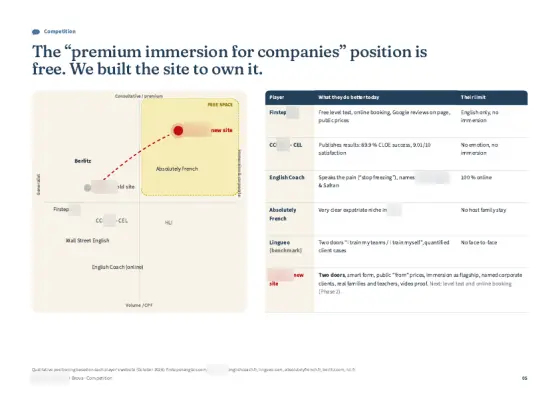
What the competition offers and what space remains open
What the visitor needs to do on each page
Why
When a website tries to speak to everyone, visitors cannot find what they need. If we know who makes the purchasing decision, every line of copy and every button is aimed at that person.
02
UX/UI design
We design the structure, the user journeys and every section, using your real content.
Site map and the journey for each type of visitor
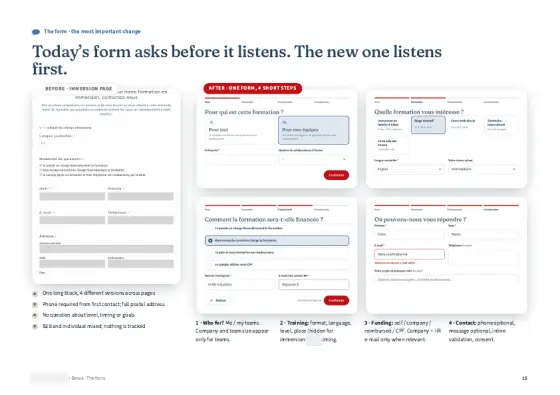
Short forms that ask about the project first
A mobile version designed from the outset
Why
Every section has to answer a question the visitor has. If it answers none, it does not belong. That is why we explain the reason behind every design decision.
03
Development
We choose the stack according to the project. For a corporate website, that may be custom code or a CMS. For a platform, a modular (MACH) architecture.
Separate components for separate jobs: content, store, forms and integrations
The components connect through APIs and work as a single system
Code reviewed by members of the team
Why
If everything lives in a single program, one vulnerable plugin or a badly executed update can bring the whole website down. Separating the components reduces that risk and lets you grow one part at a time.
04
Compliance and data
We review cookies, forms, third-party services and accessibility according to the country where your audience is.
A cookie banner where rejecting is as easy as accepting
Fonts, maps and videos that do not send data to third parties without consent
Forms with consent that ask only for the data that is needed
Accessibility to WCAG 2.2 AA
Why
Some of these details have already led to fines. Further down we share real cases.
05
Environments and releases
We work across four separate environments. Every change goes through all of them before it reaches your website. We deploy automatically from GitHub and organise the work in sprints according to the size of the project.
Local→Development→Staging→Production
Why
Nothing is tested on the website your customers see. If something fails in staging, we fix it before release.
06
Launch and SEO
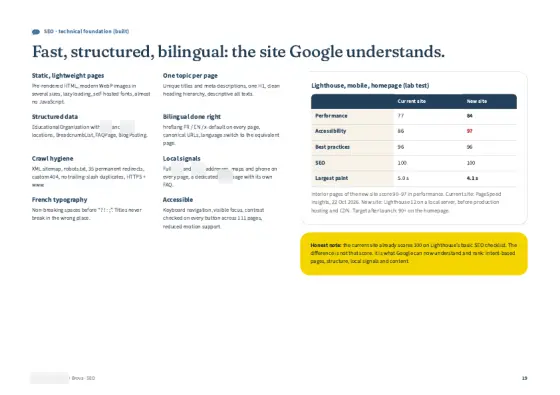
Before going live we review technical SEO and speed. After launch, we track real results in production.
A redirect from every old address to its new page
Titles, descriptions and structured data
Testing with Google Lighthouse and Search Console
Why
Changing websites without redirects can cost you rankings that took years to earn. We check them address by address.
07
Growth and data
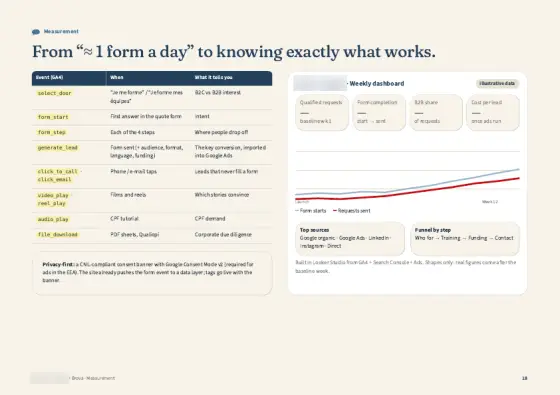
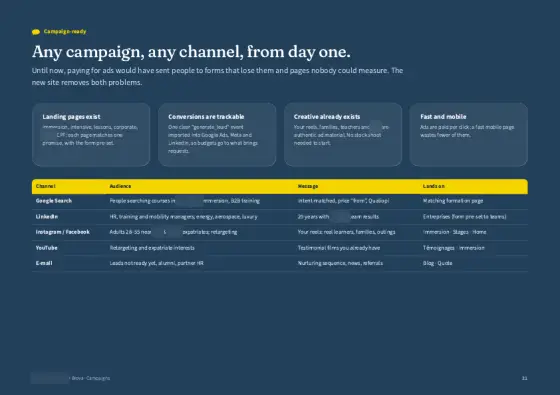
After launch we keep measuring who arrives, where from and why, using forms, content and campaigns.
A website without tracking does not improve. With data, we know which pages bring in enquiries and where visitors drop off.
Legal mistakes an AI-only website will not warn you about
An AI can build you a website that looks good. These are real cases of what may be missing underneath.
Google Fonts and your visitors’ IP addresses
In January 2022, a Munich court ordered a website to pay €100 for loading fonts from Google’s servers without consent, because doing so sends each visitor’s IP address to Google. A wave of demand letters followed in Germany and Austria. The solution is to host the fonts on your own server.
In 2019, in the Planet49 case, the Court of Justice of the EU ruled that a pre-ticked box is not valid consent. Users must accept actively, and measurement tools may only load afterwards.
Google Analytics and data transferred to the United States
In 2022, Austria’s data protection authority declared the use of Google Analytics on a website unlawful. In 2023 the EU and the United States signed a new framework, which the EU General Court upheld in September 2025. Today it can be used, with prior consent and the right configuration.
Since 28 June 2025, the European Accessibility Act has required online stores selling to consumers in the EU to be accessible, even if the company is based outside Europe. Microenterprises are exempt.
In Argentina, Law 25,326, passed in 2000, is in force. It requires informed consent and that data be used only for the stated purpose. A reform bill has yet to be approved.
Videos and maps that only load when the user clicks, spam protection that does not send data to third parties and forms that ask only for what is needed. The law does not always require it, but it protects your visitors and your company.
This information is general and does not replace legal advice for your particular case.
AI gives us speed. People make the decisions.
AI helps us research, build prototypes, review code and write tests. That saves us hours of work and shortens delivery times.
With the help of AI
Research and discovery
Prototyping and iteration
Code review
QA and automated testing
In the hands of people
Strategy and judgement
Creative direction
Client relationships
Accountability for results
One person accountable for every project
Joaquín Martinez Herrera
Founder of Brova Digital Group
Joaquín Martinez Herrera (BA) is the founder of Brova Digital Group, which he has led since 2022 together with colleagues in Argentina, the United Kingdom, Germany and Australia. His career began in infrastructure. At 15 he was administering game servers and hosting networks, and in that setting he built online stores, integrations and websites.
At 18 he took charge of IT systems for an educational institution, where he was responsible for its data centres, servers and infrastructure. At the same time he taught computing at Ott College (San Isidro), an experience that explains how he works: every technical decision is explained and documented.
He studied Systems Analysis at ORT and completed certifications from UTN and UBA in computational problem solving. He was a Microsoft Student Ambassador and studied marketing for start-ups in Cambridge (United Kingdom), as well as travelling across Europe to build partnerships with teams in different countries.
He has worked with web design and development agencies in New York and coordinated marketing with Microsoft EMEA and Americas teams at the VML agency, an experience that also drew him towards advertising. Several years earlier he volunteered at the Olympic Games for the International Olympic Committee, alongside leaders from several countries, and took part in other volunteering programmes abroad. He has also contributed to cultural projects and maintains a professional interest in IT law.
At Brova he brings infrastructure, development and marketing together in a single team, with one point of contact from the first meeting through to maintenance.



 Joaquín Martinez Herrera 5 min read