Contentful, Sanity, Hygraph, Strapi, Directus or Payload. The criteria we use to evaluate a headless CMS, what each option costs and why we end up recommending a CMS of your own.
For years, a company website lived inside a single system. WordPress or a similar CMS stored the content, assembled the pages and published them from the same application.
That model works as long as content has a single destination. Today a B2B company publishes on its website, its customer portal, its app, its PDF catalogues and its CRM. Each channel needs the same information in a different format.
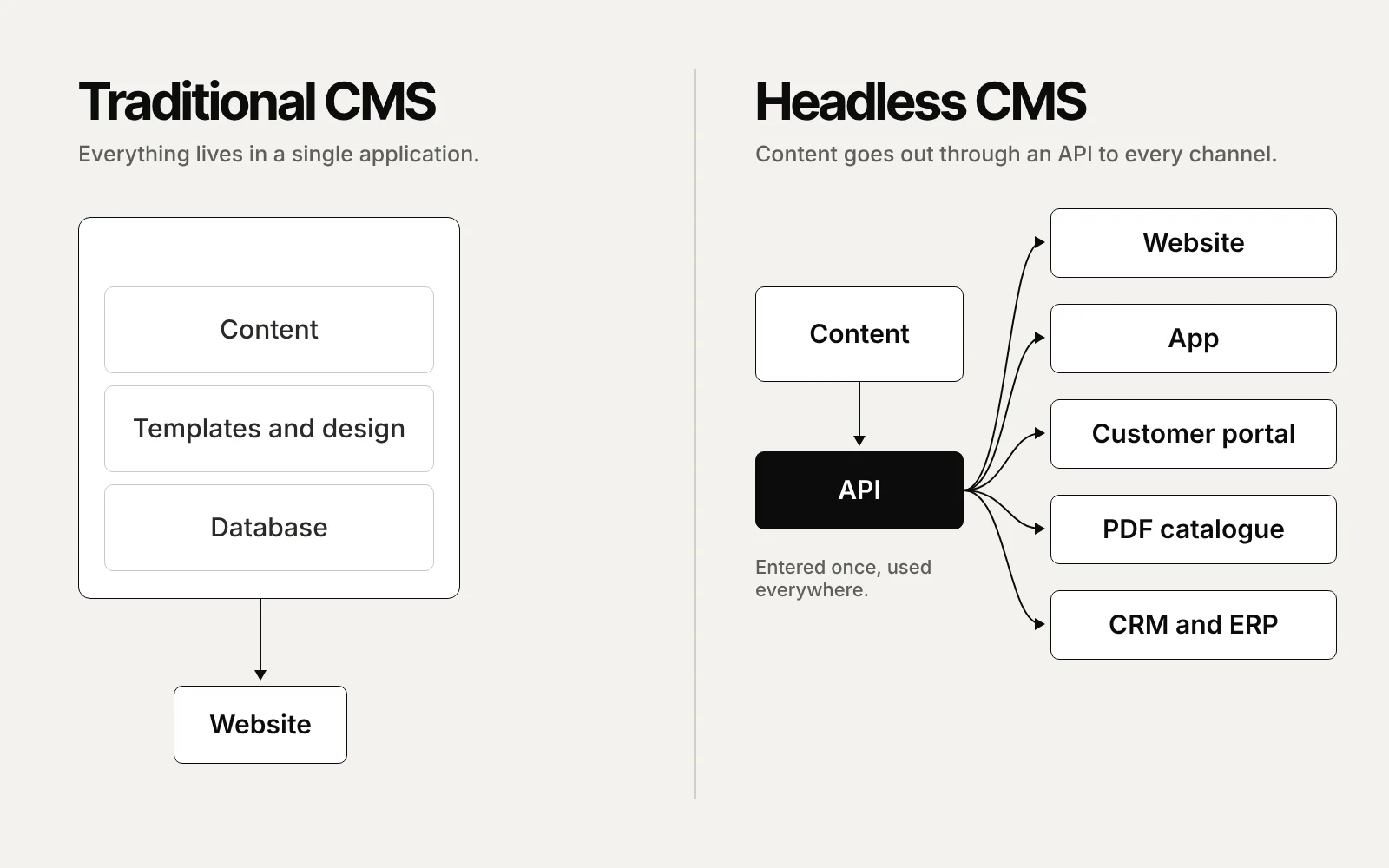
A headless CMS separates content from presentation. The team enters the information once, and the website, the app or any other system retrieves it through an API.
In a traditional CMS, everything depends on one application. In a headless CMS, the same content reaches every channel through an API.
A decision that lasts for years
A CMS is chosen for the long term. Once content, permissions and integrations depend on it, moving to another platform can take months of work.
That is why it pays to look beyond the sales demo. What matters is how the system behaves with ten editors, five languages and several channels, and what it will cost five years from now.
Six criteria for evaluating a headless CMS
1. Integration with your systems
The CMS has to connect with the tools the company already uses: CRM, ERP, search and marketing platforms. Check that it offers a documented API, automatic notifications on every change (webhooks) and the option to add your own logic when a standard integration falls short.
2. Scalability
A B2B website grows in pages, products, languages and markets. The CMS must keep pace with that growth without slowing down. It is also worth checking how the price changes with each additional user, language or API call.
3. Editor experience
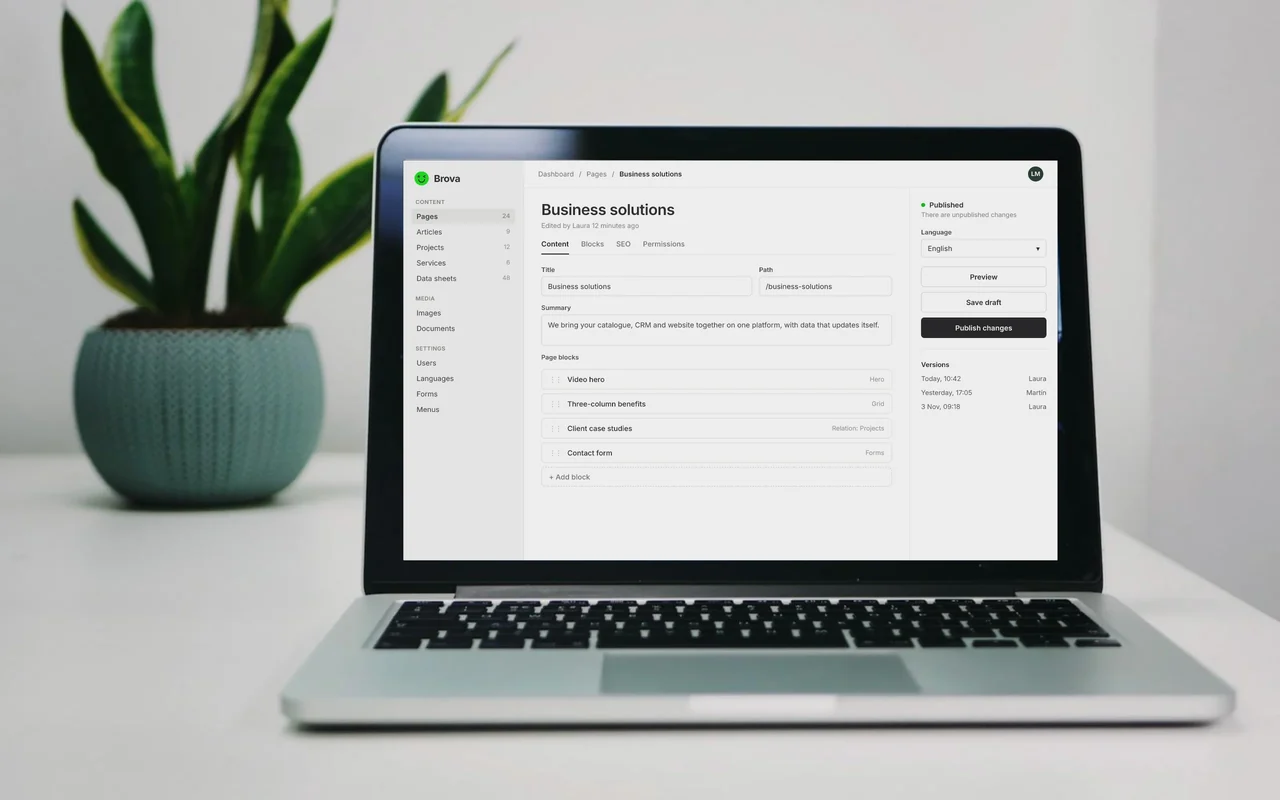
If publishing a page requires a developer, the marketing team loses its autonomy. Editors need previews, drafts, version history and clear permissions for each role.
4. Readiness for AI
AI is already part of everyday content work: translations, summaries, alternative text and internal search. A CMS with well-structured content and an open API lets you add these tools, with human review before anything is published.
5. Security and compliance
A company needs single sign-on (SSO), role-based permissions, an audit log and control over where data is stored. The GDPR in Europe and Law 25,326 in Argentina require you to know where every piece of personal data is held and who can access it.
6. Content modelling
The content model defines how each item is described: a product, a technical data sheet, a client case study. With a flexible model, the same information is reused across every channel. With a rigid one, the team ends up copying and pasting.
The criterion almost nobody puts in the comparison table. The total cost over five years. The licence is only one part of it. Additional users, languages, API traffic and the cost of migrating if the vendor changes its terms all add up.
The market in 2026
These are the platforms that come up most often when companies evaluate a CMS. Prices change frequently, so treat them as a guide and confirm them on each vendor’s website.
CMS
Licence
Hosting
Pricing model
Entry-level paid plan
Contentful
Proprietary
Vendor’s cloud
By plan, with limits on users, languages and API calls
About USD 300 per month
Sanity
Mixed: the editor is open source and the storage is proprietary
Vendor’s cloud
Per user, plus usage
USD 15 per user per month
Hygraph
Proprietary
Vendor’s cloud
By plan, with limits on users and records
USD 199 per month
Strapi
Open source (MIT)
Self-hosted or vendor’s cloud
Free when self-hosted, with paid enterprise features
Cloud from USD 15 per month
Directus
BSL: free for companies with annual revenue below USD 5 million
Self-hosted or vendor’s cloud
By plan
USD 499 per month
Payload
Open source (MIT)
Self-hosted
No licence, user or API call fees
No licence cost
Where each one fits
Contentful. The most widely deployed option among large companies, with a broad ecosystem of integrations. The jump from the free plan to the paid one is steep, and the enterprise plan is quoted separately.
Sanity. Very flexible for content modelling, with real-time collaborative editing. The cost grows with every editor, and content is always stored in Sanity’s cloud.
Hygraph. Strong in GraphQL and in combining content from several sources. Scheduled publishing and custom approval workflows are reserved for the enterprise plan.
Strapi. Open source, with a large community. Server updates and security are your team’s responsibility, and some enterprise features are paid.
Directus. Builds an API and an admin panel on top of an existing SQL database. Its licence stops being free once a company exceeds USD 5 million in annual revenue.
Payload. Open source, written in TypeScript and running inside Next.js. It has belonged to Figma since 2025 and keeps its MIT licence.
Frequently asked questions
What is the difference between a headless CMS and a traditional one?
A traditional CMS stores the content and also builds the pages. A headless CMS only manages the content and delivers it through an API, so each channel decides how to display it.
What is MACH architecture?
MACH stands for microservices, API-first, cloud-native and headless. It allows you to replace one part of the system without rebuilding the rest.
Is a headless CMS suitable for an SME?
It is when content is published in more than one place or when the website is going to grow. For a small site with only a few pages, a well-maintained traditional CMS may be enough.
Does it affect search engine rankings?
Rankings depend on how the website is built. With Next.js, pages are rendered on the server and search engines read them in full.
How long does it take to migrate to a new CMS?
It depends on the volume of content and the integrations involved. The longest stage is usually redesigning the content model and checking that every migrated page works as well as before, or better.
Our conclusion: a CMS of your own, built on Payload
After working with several of these platforms, we at Brova have reached a conclusion. For most B2B companies, the best option is a CMS of their own, built on Payload.
Growth costs nothing extra. There is no licence and no charge per editor, language or API call. The main cost is the server, which grows far more slowly than a subscription.
The content belongs to the company. It is stored in your own database on your own server. If you change provider tomorrow, you take everything with you.
The admin panel fits the business. It shows the fields, roles and workflows your team actually uses, with no unnecessary features.
It has solid backing. Payload is MIT-licensed and has belonged to Figma since 2025, which continues to publish it as open source.
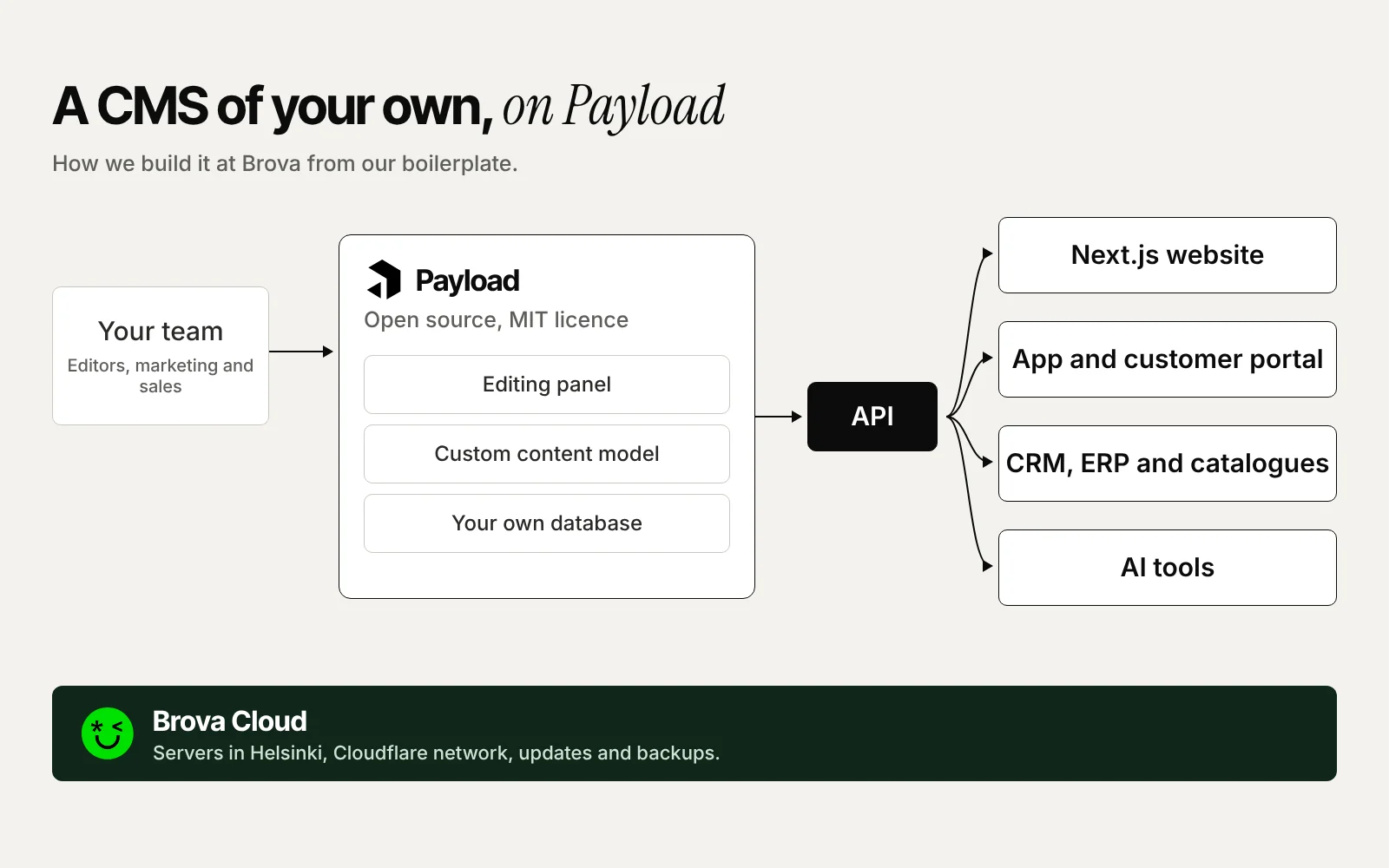
The team edits in Payload and the content reaches each channel through an API. Everything runs on Brova Cloud.
So that we never start from scratch, we have built our own boilerplate on Payload and Next.js. It includes editor and administrator roles, reusable page blocks, multiple languages, technical SEO, forms and previews. On that foundation we add whatever each company needs.
The website and the CMS are hosted on Brova Cloud, with servers in Helsinki and the Cloudflare network. We take care of updates, backups and server security.
If you are evaluating a CMS for your company, tell us what you publish today and on which channels. We will show you how it would work on Payload and what it would cost to maintain.
 Joaquín Martinez Herrera 2 min read